From COVID to Chronic Care
HealthTech
Design Manager
Multi Platform
From COVID to Chronic Care
HealthTech
Design Manager
Multi Platform
From COVID to Chronic Care
HealthTech
Design Manager
Multi Platform

Summary
MISSION
MISSION
eMed set out to make clinical-grade healthcare accessible from home, starting with COVID test-to-treat and evolving into a full chronic care platform built around GLP-1 medication management and long-term behavior change.
eMed set out to make clinical-grade healthcare accessible from home, starting with COVID test-to-treat and evolving into a full chronic care platform built around GLP-1 medication management and long-term behavior change.
CHALLENGE
CHALLENGE
The hardest design problem isn't building something new. It's evolving a platform that already serves millions without breaking what works, losing the team, or starting over. We had to do that twice. And the first time, we were doing it at a scale where a 2% error rate meant 64,000 people getting it wrong.
The hardest design problem isn't building something new. It's evolving a platform that already serves millions without breaking what works, losing the team, or starting over. We had to do that twice. And the first time, we were doing it at a scale where a 2% error rate meant 64,000 people getting it wrong.
MY CONTRIBUTION
MY CONTRIBUTION
I joined as the lead and only designer on web and mobile, working directly with the Founder and Executive team from day one. I built the design system from scratch, improved the COVID testing experience, designed the full treatment flow hands-on, and established the UX foundation that every subsequent product was built on. As the team grew I moved into the Design Manager role, mentoring and leading a team of 5 across multiple platforms and mediums. I was part of the leadership team that drove the AON enterprise partnership and UK Mounjaro expansion forward.
I joined as the lead and only designer on web and mobile, working directly with the Founder and Executive team from day one. I built the design system from scratch, improved the COVID testing experience, designed the full treatment flow hands-on, and established the UX foundation that every subsequent product was built on. As the team grew I moved into the Design Manager role, mentoring and leading a team of 5 across multiple platforms and mediums. I was part of the leadership team that drove the AON enterprise partnership and UK Mounjaro expansion forward.
CLIENT & ROLE
CLIENT & ROLE
eMed
Company
Miami, FL
Location
3 years
Duration
Design Manager
Role
Figma / Storybook Miro / Webflow
Tools
HealthTech platform design & leadership
Service
KEY OUTCOME
KEY OUTCOME
We didn't pivot. We compounded. Every capability built for COVID testing became infrastructure for chronic care. The GLP-1 platform didn't start in 2023, it started the day we built the first camera widget. On March 1, 2022, the White House launched its national "Test to Treat" COVID-19 initiative using the term eMed had trademarked. The program allowed high-risk Americans to get tested and receive free antiviral treatment in a single visit. Our platform was already doing this from home.
We didn't pivot. We compounded. Every capability built for COVID testing became infrastructure for chronic care. The GLP-1 platform didn't start in 2023, it started the day we built the first camera widget. On March 1, 2022, the White House launched its national "Test to Treat" COVID-19 initiative using the term eMed had trademarked. The program allowed high-risk Americans to get tested and receive free antiviral treatment in a single visit. Our platform was already doing this from home.
3.2m
3.2m
Concurrent patients at peak COVID season
Concurrent patients at peak COVID season
5m+
5m+
Total patients across platforms
Total patients across platforms
20%
20%
Increase in user satisfaction
Increase in user satisfaction
AON
AON
Enterprise deal to secure eMed’s market position
Enterprise deal to secure eMed’s market position
Starting point
Starting point
DISCOVERY
DISCOVERY
eMed had a working COVID testing product. The next question was inevitable: if someone tests positive at home, why should they have to start over to get treatment? The gap between a positive result and a prescription was 24 to 72 hours of friction calling a doctor, finding a pharmacy, waiting. We were already in the room. The opportunity was to close that gap entirely.
I mapped the full treatment flow end to end before designing a single screen. Two critical gaps emerged: a pre-testing moment to establish clinical eligibility, and a post-testing moment to route positive high-risk patients directly to treatment. Neither existed. Everything that followed was built to close those two gaps
eMed had a working COVID testing product. The next question was inevitable: if someone tests positive at home, why should they have to start over to get treatment? The gap between a positive result and a prescription was 24 to 72 hours of friction calling a doctor, finding a pharmacy, waiting. We were already in the room. The opportunity was to close that gap entirely.
I mapped the full treatment flow end to end before designing a single screen. Two critical gaps emerged: a pre-testing moment to establish clinical eligibility, and a post-testing moment to route positive high-risk patients directly to treatment. Neither existed. Everything that followed was built to close those two gaps
Airlines
Pre-flight testing requirements for passengers and crew at scale
Cruise Lines
Embarkation testing for thousands of passengers
School districts
Weekly testing programs for K–12 students and staff
State government
Public health testing mandates and clinical reporting
Insight: "The test was never just a test. It was the first step in a care journey. Once we saw it that way, the design direction became obvious."
Insight: Fixed income wasn’t inaccessible because of the financial product, it was inaccessible because of the experience layer.
This reframed our ambition: design a modern operating system for fixed-income portfolio construction.
PLANNING
PLANNING
I worked with product and engineering to shape a 3-phase release strategy, the result of negotiating clinical, regulatory, and engineering constraints against user experience goals. We couldn't release everything at once: medication inventory was limited, not all states approved asynchronous prescriptions, and our prescribing partners needed time to integrate.
On March 1, 2022, the White House launched its national "Test to Treat" COVID-19 initiative, using the term eMed had trademarked. Our platform was already doing it from home.
I worked with product and engineering to shape a 3-phase release strategy, the result of negotiating clinical, regulatory, and engineering constraints against user experience goals. We couldn't release everything at once: medication inventory was limited, not all states approved asynchronous prescriptions, and our prescribing partners needed time to integrate.
On March 1, 2022, the White House launched its national "Test to Treat" COVID-19 initiative, using the term eMed had trademarked. Our platform was already doing it from home.

BUILDING TREATMENT
BUILDING TREATMENT
The treatment flow had specific eligibility requirements users had to test positive, be in a high-risk group, be located in a state that accepted asynchronous prescriptions, and have treatment available near them. Routing the wrong patient into the treatment flow would erode trust fast. Every edge case had to be accounted for before we touched the UI.
I designed the medical questionnaire our prescribing physicians used to determine patient eligibility, the pharmacy picker with both local pickup and overnight delivery flows, and the confirmation and communication pattern that kept patients informed at every step. These were my hands-on designs built in close collaboration with clinical partners, engineers, and with executive signoff on every release gate.
The treatment flow had specific eligibility requirements users had to test positive, be in a high-risk group, be located in a state that accepted asynchronous prescriptions, and have treatment available near them. Routing the wrong patient into the treatment flow would erode trust fast. Every edge case had to be accounted for before we touched the UI.
I designed the medical questionnaire our prescribing physicians used to determine patient eligibility, the pharmacy picker with both local pickup and overnight delivery flows, and the confirmation and communication pattern that kept patients informed at every step. These were my hands-on designs built in close collaboration with clinical partners, engineers, and with executive signoff on every release gate.
PHASE 1
PHASE 1

Awareness: Informed users that COVID treatment was coming through eMed post-test, without disrupting the existing flow. Generated immediate demand and a surge of CS calls asking when it would launch.
Awareness: Informed users that COVID treatment was coming through eMed post-test, without disrupting the existing flow. Generated immediate demand and a surge of CS calls asking when it would launch.
PHASE 2
PHASE 2

Trusted States: Launched asynchronous treatment in Florida and Ohio. With a light integration, positive users opted in and were routed to our prescribing partner. This validated the flow with real patients before national scale.
Trusted States: Launched asynchronous treatment in Florida and Ohio. With a light integration, positive users opted in and were routed to our prescribing partner. This validated the flow with real patients before national scale.
PHASE 3
PHASE 3

Full Release: Full national rollout with the medical questionnaire, pharmacy picker, and prescription confirmation built natively into eMed. Test to prescription — in one session, from home.
Full Release: Full national rollout with the medical questionnaire, pharmacy picker, and prescription confirmation built natively into eMed. Test to prescription — in one session, from home.
Evolving the testing experience
Evolving the testing experience
DESCRIPTION
DESCRIPTION
As treatment launched, we were simultaneously expanding the testing engine to new conditions COVID + Flu, Flu only, Women's UTI, Drug testing, Lyme disease. Each new test type sharpened our understanding of how to design for different patient anxiety profiles, result communication patterns, and clinical accountability requirements. The same camera widget, ID absorption system, and proctor dashboard handled all of them.
But data from customer service told us something was wrong with how users were reading their results. Working with our data team through Grafana session analysis, we identified four root causes across hundreds of flagged sessions: language barriers with overseas proctors (40.7%), test kit interpretation confusion (31.2%), deliberate result manipulation (18.8%), and self-consciousness around sensitive test types (9.3%).
As treatment launched, we were simultaneously expanding the testing engine to new conditions COVID + Flu, Flu only, Women's UTI, Drug testing, Lyme disease. Each new test type sharpened our understanding of how to design for different patient anxiety profiles, result communication patterns, and clinical accountability requirements. The same camera widget, ID absorption system, and proctor dashboard handled all of them.
But data from customer service told us something was wrong with how users were reading their results. Working with our data team through Grafana session analysis, we identified four root causes across hundreds of flagged sessions: language barriers with overseas proctors (40.7%), test kit interpretation confusion (31.2%), deliberate result manipulation (18.8%), and self-consciousness around sensitive test types (9.3%).
RESEARCH PROCESS
RESEARCH PROCESS
I ran a structured usability study with PMs and designers paper prototyping three solutions, building hi-fi prototypes in Figma, and testing with 9 internal participants split across 3 groups using Maze. Three options competed: user self-attestation, proctor image capture, and computer vision. Self-attestation with a black-and-white color-matching UI won. We designed, tested, and shipped it in 3 weeks.
The self-attestation pattern became one of the most reusable design decisions in the platform's history. The principle give users control of their own result interpretation with clear visual anchoring carried forward into every subsequent test type and later into the GLP-1 check-in experience.
I ran a structured usability study with PMs and designers paper prototyping three solutions, building hi-fi prototypes in Figma, and testing with 9 internal participants split across 3 groups using Maze. Three options competed: user self-attestation, proctor image capture, and computer vision. Self-attestation with a black-and-white color-matching UI won. We designed, tested, and shipped it in 3 weeks.
The self-attestation pattern became one of the most reusable design decisions in the platform's history. The principle give users control of their own result interpretation with clear visual anchoring carried forward into every subsequent test type and later into the GLP-1 check-in experience.
PAPER PROTOTYPE TO HIGH FIDELITY
PAPER PROTOTYPE TO HIGH FIDELITY

Trusted States: Launched asynchronous treatment in Florida and Ohio. With a light integration, positive users opted in and were routed to our prescribing partner. This validated the flow with real patients before national scale.
Trusted States: Launched asynchronous treatment in Florida and Ohio. With a light integration, positive users opted in and were routed to our prescribing partner. This validated the flow with real patients before national scale.
MAZE TEST
MAZE TEST

SELF-ATTESTATION WIDGET
SELF-ATTESTATION WIDGET

AI trial and what it opened
AI trial and what it opened
DESCRIPTION
DESCRIPTION
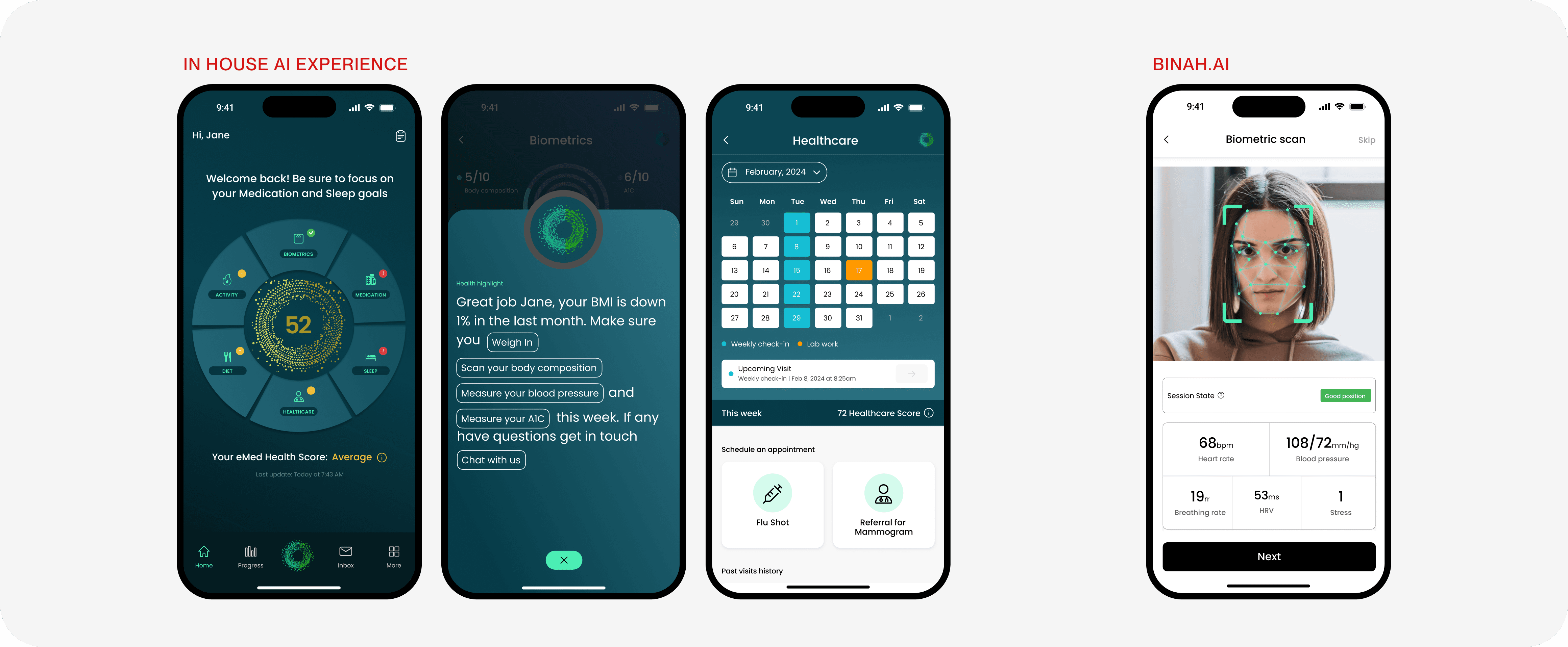
With the testing platform stable and treatment launched, the next question was how to deepen the health relationship with our patients beyond episodic testing. We explored an AI-assisted health check-in experience, a weekly self-reporting flow that synthesized sleep, medication adherence, activity, and biometric data into a single patient-facing health score.
One of my designers developed the initial concepts. As the work matured and stakeholder conversations deepened, I stepped back in to finalize the direction bringing context from executive and client conversations that weren't visible at the designer level. The resulting UI was intentionally different from the clinical aesthetic of our testing product: richer, more data-forward, designed to feel like a personal health dashboard rather than a medical form.
With the testing platform stable and treatment launched, the next question was how to deepen the health relationship with our patients beyond episodic testing. We explored an AI-assisted health check-in experience, a weekly self-reporting flow that synthesized sleep, medication adherence, activity, and biometric data into a single patient-facing health score.
One of my designers developed the initial concepts. As the work matured and stakeholder conversations deepened, I stepped back in to finalize the direction bringing context from executive and client conversations that weren't visible at the designer level. The resulting UI was intentionally different from the clinical aesthetic of our testing product: richer, more data-forward, designed to feel like a personal health dashboard rather than a medical form.
DECISIONS
DECISIONS
We made two calls that defined this phase.
We shelved the AI feature. The models weren't reliable enough for clinical-adjacent decisions and the timing wasn't right, we were simultaneously planning a native app transition that was the higher business priority. Shipping something that eroded patient trust would have undone two years of work. The AI check-in patterns weren't wasted though they became the blueprint for the GLP-1 weekly check-in experience that shipped a year later.
We acquired Binah.ai. A technology that could detect health parameters heart rate, respiratory rate, stress indicators through a standard phone camera scanning a user's face. No hardware. No wearable. Just the camera already in every patient's pocket. This acquisition quietly became the foundation of everything that came next.
We made two calls that defined this phase.
We shelved the AI feature. The models weren't reliable enough for clinical-adjacent decisions and the timing wasn't right, we were simultaneously planning a native app transition that was the higher business priority. Shipping something that eroded patient trust would have undone two years of work. The AI check-in patterns weren't wasted though they became the blueprint for the GLP-1 weekly check-in experience that shipped a year later.
We acquired Binah.ai. A technology that could detect health parameters heart rate, respiratory rate, stress indicators through a standard phone camera scanning a user's face. No hardware. No wearable. Just the camera already in every patient's pocket. This acquisition quietly became the foundation of everything that came next.
Pivoting from COVID to GLP-1
Pivoting from COVID to GLP-1
DESCRIPTION
DESCRIPTION
GLP-1 medications like Wegovy and Mounjaro produce real outcomes but adherence is fragile. Patients self-administering weekly injections need to track weight, manage side effects, stay connected to a clinical team, and sustain new habits over months. Testing is episodic. Weight management is ongoing. The UX had to shift from "complete this task" to "build this habit."
Everything built in the previous three years became the infrastructure for this shift. The camera widget became body scan and scale capture. The T2T questionnaire became clinical intake. The self-attestation pattern became weekly check-ins. The Binah.ai acquisition became facial biometric measurement. The AI check-in blueprint became the adherence flow. Nothing was wasted.
GLP-1 medications like Wegovy and Mounjaro produce real outcomes but adherence is fragile. Patients self-administering weekly injections need to track weight, manage side effects, stay connected to a clinical team, and sustain new habits over months. Testing is episodic. Weight management is ongoing. The UX had to shift from "complete this task" to "build this habit."
Everything built in the previous three years became the infrastructure for this shift. The camera widget became body scan and scale capture. The T2T questionnaire became clinical intake. The self-attestation pattern became weekly check-ins. The Binah.ai acquisition became facial biometric measurement. The AI check-in blueprint became the adherence flow. Nothing was wasted.
NOTIFICATIONS & AUTHENTICATION
NOTIFICATIONS & AUTHENTICATION

Note: The first moments in the app set the tone for the entire program. We designed a two-step trust sequence: permission to notify followed immediately by Face ID setup. Both are opt-in, both are framed around patient benefit staying informed and staying secure rather than platform requirements. The sequence was designed to maximize acceptance without pressure.
Note: The first moments in the app set the tone for the entire program. We designed a two-step trust sequence: permission to notify followed immediately by Face ID setup. Both are opt-in, both are framed around patient benefit staying informed and staying secure rather than platform requirements. The sequence was designed to maximize acceptance without pressure.
IDENTIFICATION VERIFICATION & CLINICAL INTAKE
IDENTIFICATION VERIFICATION & CLINICAL INTAKE

Note: Before any medication is prescribed, eMed needs to know who you are and whether you qualify. Identity verification uses government-issued ID scanning designed to work in variable lighting, on any device, in under 60 seconds. The medical intake that follows collects clinical history through a focused questionnaire built to surface eligibility without overwhelming the patient. Both flows carry forward directly from the COVID test-to-treat infrastructure I designed in 2021.
Note: Before any medication is prescribed, eMed needs to know who you are and whether you qualify. Identity verification uses government-issued ID scanning designed to work in variable lighting, on any device, in under 60 seconds. The medical intake that follows collects clinical history through a focused questionnaire built to surface eligibility without overwhelming the patient. Both flows carry forward directly from the COVID test-to-treat infrastructure I designed in 2021.
IDENTIFICATION VERIFICATION & CLINICAL INTAKE
IDENTIFICATION VERIFICATION & CLINICAL INTAKE

Note: Three measurement systems all camera-based, all designed to work without additional hardware. Binah.ai facial scanning captures heart rate, blood pressure, breathing rate, and stress through the front camera. Scale integration uses the rear camera to detect weight from a smart scale display inside a guided frame. Full body scan captures posture and composition through a structured pose sequence with real-time alignment feedback. The Binah.ai capability came from an acquisition I was part of. The design layer, guidance, framing, confidence indicators, and error states was built by my team under my direction.
Note: Three measurement systems all camera-based, all designed to work without additional hardware. Binah.ai facial scanning captures heart rate, blood pressure, breathing rate, and stress through the front camera. Scale integration uses the rear camera to detect weight from a smart scale display inside a guided frame. Full body scan captures posture and composition through a structured pose sequence with real-time alignment feedback. The Binah.ai capability came from an acquisition I was part of. The design layer, guidance, framing, confidence indicators, and error states was built by my team under my direction.
WEEKLY CHECK-IN
WEEKLY CHECK-IN

Note: The weekly check-in is the behavioral heart of the GLP-1 program. It surfaces three things every week side effect monitoring, weight recording, and injection tracking in a flow designed to complete in under 90 seconds. The calendar view shows injection history at a glance: on time, late, or missed. As the schedule slips the UI responds escalating from a blue reminder to an amber warning to a pink skip recommendation giving clinical context without clinical language. The feedback loop at completion keeps the experience conversational rather than transactional.
Note: The weekly check-in is the behavioral heart of the GLP-1 program. It surfaces three things every week side effect monitoring, weight recording, and injection tracking in a flow designed to complete in under 90 seconds. The calendar view shows injection history at a glance: on time, late, or missed. As the schedule slips the UI responds escalating from a blue reminder to an amber warning to a pink skip recommendation giving clinical context without clinical language. The feedback loop at completion keeps the experience conversational rather than transactional.
HOME
HOME

Note: The home screen is a widget-based dashboard designed to surface the most relevant action for each patient at each moment in their program. First-time users see journey guidance. Returning users see their check-in status, active orders, refill information, and latest clinical reports. Every widget is fixed or dynamic based on program state the architecture was defined during the native app strategy phase and handed to my Sr. Product Designer to execute, with me guiding the information hierarchy and content decisions throughout. The Progress tab surfaces weight trend, current weight, and weekly delta, the three numbers that tell a GLP-1 patient everything they need to know about how their program is going.
Note: The home screen is a widget-based dashboard designed to surface the most relevant action for each patient at each moment in their program. First-time users see journey guidance. Returning users see their check-in status, active orders, refill information, and latest clinical reports. Every widget is fixed or dynamic based on program state the architecture was defined during the native app strategy phase and handed to my Sr. Product Designer to execute, with me guiding the information hierarchy and content decisions throughout. The Progress tab surfaces weight trend, current weight, and weekly delta, the three numbers that tell a GLP-1 patient everything they need to know about how their program is going.
MARKET EXPANSION
MARKET EXPANSION
The platform launched in two significant markets. In the UK, eMed partnered with Mounjaro (tirzepatide) building localized flows for a different medication, regulatory environment, and patient expectation. In the US, a landmark enterprise deal with AON brought the GLP-1 program to AON's corporate client base as an employer health benefit. The AON partnership was the deal that secured eMed's position in the market.
I was part of the leadership team that drove both partnerships forward. I finished my tenure at eMed as the platform was launching and the AON deal was closing. The foundation I built made both possible.
The platform launched in two significant markets. In the UK, eMed partnered with Mounjaro (tirzepatide) building localized flows for a different medication, regulatory environment, and patient expectation. In the US, a landmark enterprise deal with AON brought the GLP-1 program to AON's corporate client base as an employer health benefit. The AON partnership was the deal that secured eMed's position in the market.
I was part of the leadership team that drove both partnerships forward. I finished my tenure at eMed as the platform was launching and the AON deal was closing. The foundation I built made both possible.
Results
Results
OVERVIEW
OVERVIEW
I started as the only designer at eMed. By 2023 I was managing 5 designers across web, iOS, Android, and the clinical proctor dashboard simultaneously. The most important leadership decision I made wasn't a design decision. It was knowing when to hold the pen and when to hand it over.
During COVID I was hands-on because the stakes were high and there was no team. As the platform matured I made deliberate choices to delegate using the native app and GLP-1 execution as growth vehicles for my Sr. Product Designer while I stayed close through strategy, reviews, and stakeholder alignment. I introduced a weekly design review cadence, restructured Figma around shared libraries reducing duplicated work by ~40%, and built growth tracks that kept two designers from leaving when they were approached by other teams.
I started as the only designer at eMed. By 2023 I was managing 5 designers across web, iOS, Android, and the clinical proctor dashboard simultaneously. The most important leadership decision I made wasn't a design decision. It was knowing when to hold the pen and when to hand it over.
During COVID I was hands-on because the stakes were high and there was no team. As the platform matured I made deliberate choices to delegate using the native app and GLP-1 execution as growth vehicles for my Sr. Product Designer while I stayed close through strategy, reviews, and stakeholder alignment. I introduced a weekly design review cadence, restructured Figma around shared libraries reducing duplicated work by ~40%, and built growth tracks that kept two designers from leaving when they were approached by other teams.
FINAL REFLECTION
FINAL REFLECTION
The thing I'm most proud of from eMed isn't any single screen. It's that we built a team and a system flexible enough to evolve from a pandemic product to a chronic care platform without starting over. The camera widget built in 2021 was still at the center of the product in 2024. The check-in patterns we tested and shelved in the AI exploration came back as the backbone of the GLP-1 adherence flow. The self-attestation widget built in 3 weeks became a core piece of the clinical experience.
Good design infrastructure compounds. That's the lesson.
The thing I'm most proud of from eMed isn't any single screen. It's that we built a team and a system flexible enough to evolve from a pandemic product to a chronic care platform without starting over. The camera widget built in 2021 was still at the center of the product in 2024. The check-in patterns we tested and shelved in the AI exploration came back as the backbone of the GLP-1 adherence flow. The self-attestation widget built in 3 weeks became a core piece of the clinical experience.
Good design infrastructure compounds. That's the lesson.